
33.794033, -84.318393
Digital Health Incubator in Atlanta
Social media




Menu

33.794033, -84.318393
Digital Incubator Based in Atlanta
Social media


Menu
Menu
RAPID PULSE OXIMETRY INTERPRETATION
RAPID PULSE OXIMETRY INTERPRETATION
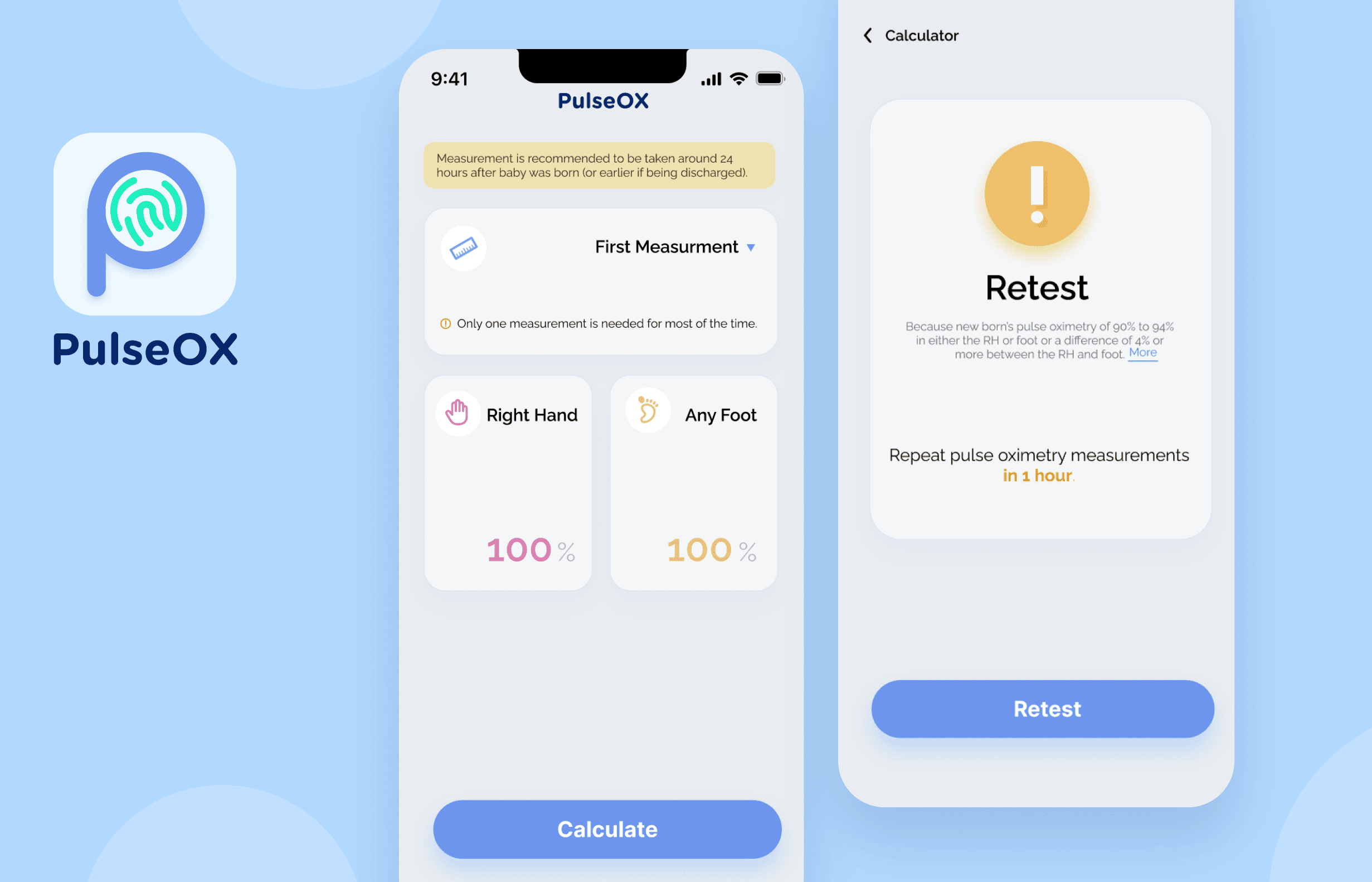
PulseOx aids in the rapid and accurate interpretation of pulse oximetry findings obtained as part of newborn screening for critical congenital heart disease (CCHD).
PulseOx aids in the rapid and accurate interpretation of pulse oximetry findings obtained as part of newborn screening for critical congenital heart disease (CCHD).

Roughly 7,200 babies are born with a Critical Congenital Heart Defect (CCHD) each year
In 2011, pulse oximetry screening was recommended to improve the detection of critical congenital heart defects (CCHD) in newborns.
Approximately 4 million infants are screened for CCHD in the United States each year.
This application was developed by Children's Healthcare of Atlanta to aid healthcare professionals in implementing pulse oximetry screening in the newborn nursery
In 2011, pulse oximetry screening was recommended to improve the detection of critical congenital heart defects (CCHD) in newborns.
Approximately 4 million infants are screened for CCHD in the United States each year.
This application was developed by Children's Healthcare of Atlanta to aid healthcare professionals in implementing pulse oximetry screening in the newborn nursery
Children's Healthcare of Atlanta
User Research, UX Design, App Development, User Testing
Matt Oster
Professor, Emory University
Interpreting Pulse oximetry results is not easy.
Interpreting Pulse oximetry results is not easy.
Human error in interpretation can lead to delayed screening.
Human error in interpretation can lead to delayed screening.
Undetected CCHD can become a medical emergency.
Undetected CCHD can become a medical emergency.
CCHD's screening algorithm is complex and easy to misapply
CCHD's screening algorithm is complex and easy to misapply
PulseOX aids in rapid interpretation of pulse oximetry findings by reducing mistakes obtained by human error.
PulseOX aids in rapid interpretation of pulse oximetry findings by reducing mistakes obtained by human error.